1. Why is multitasking considered by many psychologists to be a myth?
Multitasking looks like people are doing several activities at the same time. They're not. They're doing them sequentially, switching rapidly between them.
Substantial interference effects occur when you try to use the same channel. For example, if you're on the phone, you may be able to read a note that someone has passed you even while you’re listening to the person on the other end of the line. But you won't be able to fully understand someone who starts talking to you while you’re listening or talking to someone else.
2. To what does the term "response selection bottleneck" refer?
We examined the coordination of processing streams when two reaction stimuli are presented with minimal temporal separation. We tested the hypothesis that individuals that grouped responses to the two stimuli would schedule response preparation later than those not-grouping their responses would. Performance measures were combined with a cardiac measure interpreted as an index of response inhibition.
3. David Meyer has found that multitasking contributes to the release of stress hormones and adrenaline. Why is this important?
martes, 7 de septiembre de 2010

lunes, 6 de septiembre de 2010
Bambuti Pygmies

The most important god of the Bambuti pantheon is Khonvoum, a god of the hunt who wields a bow made from two snakes that together appear to humans as a rainbow. After sunset every day, Khonvoum gathers fragments of the stars and throws them into the sun to revitalize it for the next day. He occasionally contacts mortals through Gor or a chameleon. Khonvoum created mankind from clay. Black people were made from black clay, white people came from white clay, and the Pygmies themselves came from red clay. He also creates the animals that are needed by hunters. Arebati is a lunar deity and Sky Father. In some sources, he was said to have created humanity from clay, instead of Khonvoum. Tore is a god of the forests who supplies animals to hunters. He is also a thunder god who appears as a storm and hides in rainbows. Most importantly, Tore appears as a leopard in the initiation rites. The first Pygmies stole fire from Tore he chased them but could not catch them, and when he returned home, his mother had died. As punishment, he decreed that humans would also die, and he thus became the death god. Pygmy peoples see their rainforest homes threatened by logging, and are driven out by settlers. In some places they have been evicted and their land has been designated as national parks. They are routinely deprived of their rights by governments, which do not see these forest-dwellers as equal citizens. In Cameroon, the life of the Bagyeli is being disrupted by a World Bank-sponsored oil pipeline which is to be built through their land. The Batwa of eastern DRC, Rwanda, Burundi and Uganda have seen nearly all their forest destroyed, and barely survive as laborers and beggars.
Colin Turnbull

World War II brought a stint in the Royal Naval Volunteer Reserve after which he was awarded a two year grant in the Department of Indian Religion and Philosophy, Banaras Hindu University, India, from which he graduated with a master's degree in Indian Religion and Philosophy. In 1951, after his graduation from Banaras, he traveled to the present-day Democratic Republic of the Congo with Newton Beal, an Ohio schoolteacher he'd meet in India. Turnbull and Beal first studied the BaMbuti pygmies during this time, though that was not the complete goal of the trip. An odd job Turnbull picked up while in Africa at this time was working for the Hollywood producer Sam Spiegel. Spiegel hired Turnbull to assist in the construction and transportation of a boat needed for his film. This boat was The African Queen, which was used for the film of the same title. After his first trip to Africa, Turnbull traveled to Yellowknife in the northwest territories of Canada, where he worked as a geologist and gold miner for approximately a year, before he went back to school to obtain another degree. Upon returning to Oxford in 1954, he began specializing in the anthropology of Africa. Turnbull remained in Oxford for two years before another field trip to Africa, finally focusing on the then-Belgian Congo and Uganda. After years of fieldwork, he finally achieved his anthropology doctorate from Oxford in 1964.
martes, 24 de agosto de 2010
What influences our perception?
Messages that tell us we are expected to fulfill roles influence our perceptions. Demands of our roles influence our perceptions. Cognitive abilities shape our perceptions and cognitive complexity refers to the number of different knowledge schema used to organize and interpret people and situations. Cognitively complex people tend to be flexible in interpreting complicated phenomena and integrating new information into their thinking about people and situations. Less cognitively complex people are likely to ignore information that doesn’t fit neatly with their perceptions or to use it to replace the impressions they had formed. Person-centered perception is the ability to perceive another as a unique and distinct individual. Person-centered perception reflects cognitive complexity because it entails abstract thinking and a broad range of schemata. Person-centered perception is not the same as empathy is the ability to feel with another person.
miércoles, 18 de agosto de 2010
Perception is Reality
A phrase that comes up a lot now a day is "Perception is Reality." Although this concept is wrong on a factual basis, it is reality in terms of living in today's society in which interacting and relating to others is a necessity for survival and success in today's world.One thing that can fog a person's perception is biases created by past experiences. Take, for example, the perception of the world a person might have if they were raised in a loving, supportive family. That particular individual's perception of self and others, and the world we live in, would be one of optimism, which opens the mind, creating a filter that feeds the individual the information that will help a person grow and succeed.
Why is Psychology important to me?
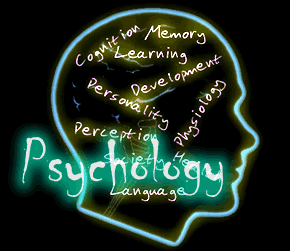
Psychology is important to me because I had learned many things, for example I’ve learned that life has many different perspectives it's just the way you are raised by your parents. What I like more is that in psychology opens your eyes in many different ways so you can help open other people eyes.
lunes, 16 de agosto de 2010
Suscribirse a:
Entradas (Atom)